According to Gartner, more than 60% of AI projects fail to move beyond pilot stages due to challenges related to data readiness, integration complexity, and deployment gaps. The real challenge today is to build reliable, scalable, and production-ready AI systems grounded in strong data foundations. The Applied AI and Data Science Program, offered by MIT Professional Education, provides a structured path from data fundamentals and Machine Learning models to Generative AI, Agentic AI, and multi-agent workflows using LangGraph, RAG, and Claude.
Delivered online over 15 weeks through weekly live lectures from MIT faculty, the program develops the technical understanding and practical skills needed to apply AI to real business problems. Through expert-led instruction, hands-on projects, and case studies, you will develop the intuition and strategic judgment needed to build and evaluate AI systems.
THIS PROGRAM MAY BE TAKEN AS A STANDALONE PROGRAM OR AS PART OF THE PROFESSIONAL CERTIFICATE PROGRAM IN MACHINE LEARNING & ARTIFICIAL INTELLIGENCE. COMPLETING THE COURSE WILL CONTRIBUTE 5 DAYS TOWARDS THE CERTIFICATE.
In this 15-week program, you will develop the technical foundations and practical expertise to build and evaluate AI systems. Starting with AI-assisted Python programming, statistics, and data preparation, you will progress through Data Science, Machine Learning, Deep Learning, and Recommendation Systems before exploring Generative AI and Agentic AI workflows.
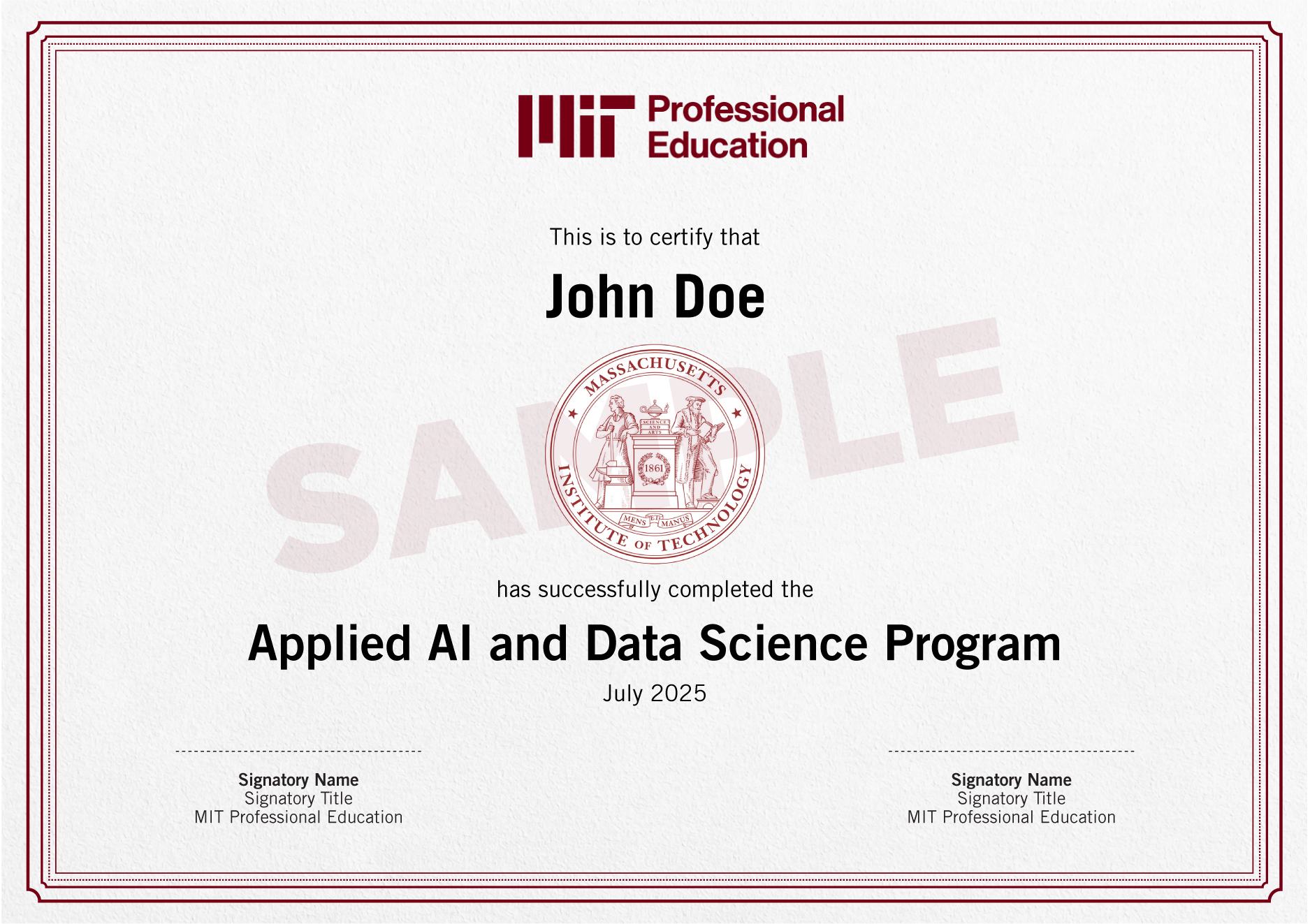
Upon successful completion of the program requirements, you will earn a Certificate of Completion from MIT Professional Education and 16 Continuing Education Units (CEUs).
Certificate of Completion from MIT Professional Education
The program features mentorship from Data Science and Machine Learning experts through live and personalized mentored learning sessions. Mentors will guide you in applying concepts to various industry case studies and projects, helping you develop practical skills and understand how AI and Data Science techniques are applied across business contexts.
- Omar Attia - Senior Research Engineer, Apple
- Bhaskarjit Sarmah - Director, BlackRock
- Vibhor Kaushik - Senior Machine Learning Scientist, Amazon
- Nirmal Budhathoki - Senior Data Scientist, Microsoft
- Mohit Khakaria - Senior Machine Learning Engineer, Ford Motor Company
- Rohit Dixit - Senior Data Scientist, Siemens Healthineers
- Vaibhav Verdhan - Senior Director Global, AstraZeneca
- Udit Mehrotra - Data Scientist, Google
- Amish Suchak - Data Science Team Lead, XSOLIS
- Nirupam Sharma - Data Science Vice President, Big Village
- Deepa Krishnamurthy - Director, AI Solutions Engineering, Koru
- Marco De Virgilis - Actuarial Data Scientist Manager, Arch Insurance Group Inc.
- Cristiano Santos De Aguiar - Biomedical Machine Learning Engineer, Oncoustics
- Matt Nickens - Senior Manager, Data Science, CarMax
- Saber Fallahpour - Principal Data Scientist, Altair
- Asim Sultan - Senior Machine Learning Engineer, RiskHorizon AI
Learn From Industry Experts
Learn from experienced Data Science and Machine Learning professionals who bring practical industry perspectives to the program. Through 8+ hours of recorded video lectures and live mentored learning sessions, you will gain insights into how technical concepts and AI techniques are applied to real-world problems.
Mentors will guide you through industry case studies and projects, helping you connect theoretical foundations with practical applications across different business domains.
How do mentorship sessions work?
Mentoring sessions occur in small groups that are called micro classes. You will be grouped with learners with similar years of experience and backgrounds so that the mentors can determine the right pace of teaching, level of techniques, and relevant case studies, to use in order to maximize the benefit. When learning in groups, you can also garner how a practical skill like data science is applied to different industry-specific problems. In addition, you will work with the mentors every weekend to brush up on topics and revisit the concepts you covered earlier.
Mentors take you from conceptualization to implementation by explaining complex concepts and guiding you through hands-on assignments. Here are a few ways mentors add to your learning experience:
- Build tangible skills through interactive, hands-on coding walkthroughs
- Gain Industry expertise from experienced data scientists at globally renowned companies such as Apple, Microsoft, Blackrock, etc.
- Connect theoretical concepts to actual practical examples of how these analytic techniques are used across various industries
- Engage with your mentor on a deeper level and get support and guidance when making the transition into a data science career
- Prepare for your interviews and foster data-driven problem-solving within teams
Pre-Work: Python, Data Science, and AI Foundations
Establish the coding and conceptual foundations needed for the program. The pre-work introduces Python fundamentals, probability and descriptive statistics, the origins and paradigms of Data Science and AI, and the Data Science lifecycle.
You will also explore industry applications of Data Science and AI across sectors such as retail, healthcare, and banking, preparing you to engage with the technical concepts covered throughout the program.
About Great Learning
Great Learning is a global EdTech company offering professional and higher education programs in blended, classroom, and online modes across technology, data and business domains.
The MIT Professional Education's Applied AI and Data Science Program, with a curriculum developed and taught by MIT faculty, is delivered in collaboration with Great Learning.
Contact Great Learning for more information at aaidsp.mit@mygreatlearning.com or call +1 617 468 7899 / +91 9606 053 237.
- Apply Python and AI coding assistants to build, debug, and evaluate code for real-world Data Science tasks.
- Use statistical reasoning and Machine Learning techniques to analyze data, build predictive models, and rigorously evaluate performance.
- Design and train Deep Learning models, including CNNs and transfer learning pipelines, for pattern recognition and advanced prediction tasks.
- Build end-to-end AI systems for recommendation engines, time-series forecasting, and unsupervised pattern discovery.
- Construct single-agent and multi-agent AI systems using LangGraph, RAG, and production frameworks to solve autonomous business problems.
- Evaluate and deploy Agentic AI workflows using key performance metrics such as tool accuracy and adaptive reasoning quality.
MIT Professional Education's Applied AI and Data Science Program, with curriculum developed and taught by MIT faculty, is delivered in collaboration with Great Learning. Unique to the Applied AI and Data Science Program is a dedicated Program Management Team, provided by Great Learning, which will be your single point of contact for all academic and non-academic queries in the program. They will keep track of your learning journey, give you personalized feedback, and provide the required nudges to ensure your success.
The program is 15 weeks long:
Week 1 - 2
- AI-assisted Python programming
- Statistics and data preparation
- The end-to-end Data Science lifecycle
- A hands-on project using Python
Week 3 - 10
- Data Analysis and Visualization
- Machine Learning
- Practical Data Science
- Deep Learning
- Recommendation Systems
Two dedicated refresher break weeks 8–10 mentor learning session notebooks and an elective project
Week 11 - 12
- Generative AI and Agentic AI foundations
- Single-agent and multi-agent workflows
- LangGraph and RAG
- Evaluating Generative AI and Agentic AI workflows
- A three-week Capstone Project based on your choice of topic
Week 13 - 15 : Capstone Project
Design and deliver an end-to-end AI solution for a selected problem statement, integrating concepts and techniques from across the program.
- Data Analysis and Visualization / Unsupervised Learning
- Machine Learning / Regression
- Practical Data Science / Classification
- Deep Learning
- Recommendation Systems
- Generative AI and Agentic AI
The program also includes self-paced modules on Ethical and Responsible AI and Claude-based AI workflows, along with an Anthropic masterclass.
- Senior technology professionals and architects ready to move beyond experimenting with AI toward designing and deploying production-grade AI systems and multi-agent workflows.
- Early-career professionals experimenting with GenAI tools who want to build a rigorous technical foundation in Data Science, Machine Learning, and Agentic AI systems.
- Professionals transitioning into AI and Data Science roles seeking hands-on expertise in Python, Machine Learning, Agentic AI systems, and modern AI frameworks and tools such as LangChain, LangGraph, and Claude.
Prerequisites: Exposure to computer programming and a high school-level knowledge of Statistics and Mathematics.
Testimonials