
In our age of information and insights, the success of a business relies on how well we utilize the data in creating algorithms and making predictions. As organizations realize this, no-code approaches to implementing emerging technologies are becoming popular and essential to know. A no-code approach to data science and AI can be a game-changer. MIT Professional Education offers the No Code and Agentic AI program to utilize the full power of AI and build intelligent solutions from data without having to write a single line of code.
In this 14-week program, you will learn to use AI and Machine Learning to make data-driven business decisions by understanding the theory and practical applications of supervised and unsupervised learning, neural networks, recommendation engines, computer vision, Agentic AI, etc. Leverage the power of Generative and Agentic AI without writing a single line of code.
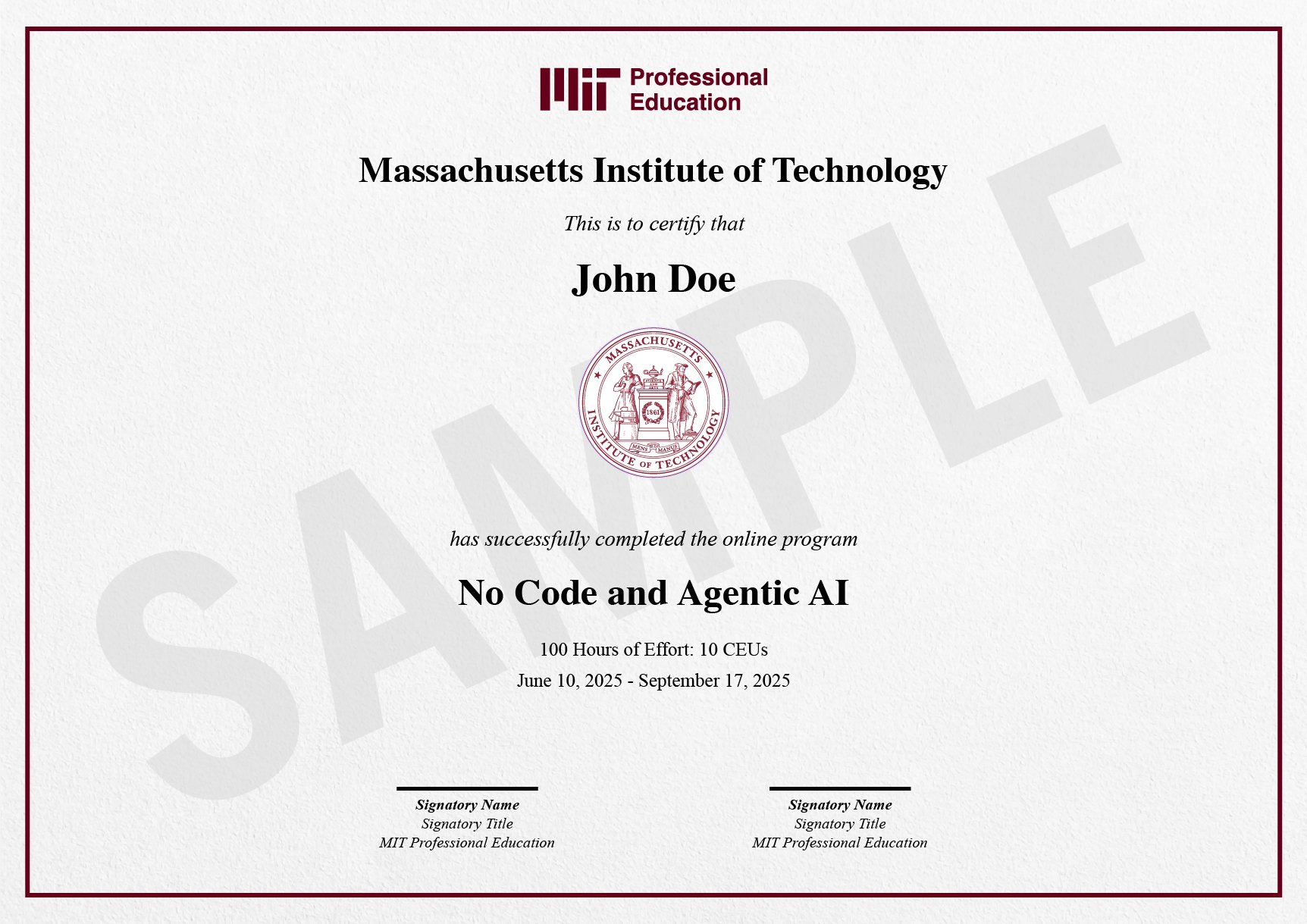
Upon successfully completing the program, you will receive a certificate of completion from MIT Professional Education.
Machine learning and AI techniques have generated significant interest across industries. With the emergence of no-code platforms, professionals from diverse sectors can now harness the power of these technologies without prior programming knowledge. These intuitive, interactive user interfaces enable users to efficiently classify information, conduct data analysis, and develop precise predictive models, eliminating the need for complex programming. In this program, you will learn to use different no-code tools to create innovative solutions. It includes modules on Generative AI, Prompt Engineering, Retrieval-Augmented Generation (RAG), and Agentic AI, equipping you with a comprehensive understanding of cutting-edge AI capabilities.
Program Mentors
With mentored learning, you can accelerate your learning, increase productivity, have a better grasp of the subject and discover new problem-solving perspectives.
The program mentors coach you to work on hands-on industry-relevant projects by AI and machine learning experts via live and personalized mentoring and learning sessions to give you a practical understanding of core concepts.
Cristiano Santos de Aguiar – Lead Data Scientist, Bresotec Medical
Jatin Dawar – Senior Machine Learning Engineer, TELUS
Olabode James – Machine Learning Architect, Rubik Technologies
Peyman Hessari – Sr. Data Scientist, ATB Financial
Note: The above list is indicative and subject to change.
How do mentorship sessions work?
Mentoring sessions occur in small groups that are called micro classes. You will be grouped with learners with similar years of experience and backgrounds so that the mentors can determine the right pace of teaching, level of techniques, and relevant case studies, to use in order to maximize the benefit. When learning in groups, you can also garner how practical skills like Agentic AI and Machine Learning are applied to different industry-specific problems. In addition, you will work with the mentors every weekend to brush up on topics and revisit the concepts you covered earlier.
Mentors take you from conceptualization to implementation by explaining complex concepts and guiding you through hands-on assignments. Here are a few ways mentors add to your learning experience:
- Build tangible skills through interactive, hands-on coding walkthroughs
- Gain Industry expertise from experienced data scientists at globally renowned companies.
- Connect theoretical concepts to actual practical examples of how these analytic techniques are used across various industries
- Engage with your mentor on a deeper level and get support and guidance when making the transition into a data science career
- Prepare for your interviews and foster data-driven problem-solving within teams
MIT Professional Education is collaborating with online education provider Great Learning to offer No Code and Agentic AI. This program leverages MIT's leadership in innovation, science, engineering, and technical disciplines developed over years of research, teaching, and practice. Great Learning collaborates with institutions to manage enrollments (including all payment services and invoicing), technology, and participant support.
Contact Great Learning for more information at ncai.mit@mygreatlearning.com or call +1 617 860 3529
- Develop a working understanding of AI, from classical machine learning to autonomous agents, to make informed decisions and engage in meaningful conversations.
- Design, run, and test AI workflows using intuitive no code tools for rapid experimentation and deployment.
- Understand large language models and apply Prompt Engineering to produce reliable outputs and build Generative AI workflows for business automation.
- Apply clustering, classification, and regression with no code tools to uncover patterns, predict outcomes, and support data-driven decisions.
- Develop Retrieval-Augmented Generation (RAG) pipelines that connect models to trusted data sources, improving accuracy and reducing hallucinations.
- Build autonomous agents that can plan, use tools, retain memory, and execute complex multi-step tasks.
- Design systems where multiple AI agents collaborate to handle complex tasks, with methods to measure and improve performance.
- Use structured evaluation methods to assess the accuracy, reliability, and quality of AI outputs before deployment.
Program Curriculum
The No Code and Agentic AI program is a 14-week course that offers a comprehensive learning experience. Esteemed MIT Faculty lead the program and incorporate a blended learning approach with recorded lectures, real-life case studies, hands-on projects, interactive quizzes, mentor-led sessions, and engaging webinars.
These 14 weeks will be distributed in the following manner:
Pre-Work: AI Foundations + No-Code Tool Setup & Onboarding
Week 1: AI, Gen AI, and Agentic AI Landscape
Week 2: LLMs and Prompt Engineering
Week 3: Data Exploration
Week 4: Prediction Methods — Regression
Week 5: Prediction Methods — Decision Systems
Week 6: Recommendation Systems
Week 7: Project Week
Week 8: Learning Break
Week 9: Build Workflows on Proprietary Data and Business Context
Week 10: Evaluating Generative AI Workflows
Week 11: Project Week
Week 12: Single Agent Systems
Week 13: Build Autonomous Systems Using Multi-Agents
Week 14: Project Week
Pre-Work: AI Foundations + No-Code Tool Setup & Onboarding
Establish a foundational understanding of data-driven decision-making and gain hands-on experience with no-code tools before the program begins.
- Origins of data-driven decision-making
- Paradigms of Data Science and AI
- Role of mathematics and statistics in AI/DS
- Environment setup for KNIME and n8n
- Navigating interfaces and core functionalities
- Building and executing your first AI workflow
Week 1: AI, Gen AI, and Agentic AI Landscape
Understand the full arc of AI evolution and contextualize where Generative and Agentic AI fit within the broader landscape.
- AI evolution & architectural shifts: rule-based systems → ML → deep learning → transformers → generative AI → agentic systems
- Key architectural breakthroughs driving each transition
- The evolution and challenges of data operations
- Use cases and practical applications of data operations
Week 2: LLMs and Prompt Engineering
Understand how large language models work and apply prompt engineering techniques to produce reliable, high-quality outputs.
- Evolution of generative models
- Mechanics of diffusion models and LLMs
- Challenges, hallucinations, and alignment
- Common use cases: chatbots, content generation, summarization
- Impact on decision-making: speed, scalability, limitations
- raining process of foundation models and in-context learning
- Prompt engineering techniques for improving output quality and consistency
Week 3: Data Exploration
Apply clustering and dimensionality reduction techniques to segment data and extract meaningful patterns.
- K-means clustering
- K-medoids clustering
- Gaussian mixture models (GMM)
- Applying clustering for data segmentation and pattern extraction
- Principal component analysis (PCA)
- t-SNE for visualization
- Transforming high-dimensional data into interpretable representations
Week 4: Prediction Methods — Regression
Build and evaluate regression models using no-code tools to predict numerical outcomes and identify key drivers.
- Fundamentals of supervised learning
- Linear regression for predicting numerical outcomes
- Interpreting model outputs to identify key drivers
- Using KNIME for regression workflows
- Testing basic statistical assumptions
- Applying performance metrics for model evaluation
Week 5: Prediction Methods — Decision Systems
Apply classification techniques and ensemble methods to real-world categorization problems, including text classification using LLMs.
- Fundamentals of classification in supervised learning
- Decision trees for categorization and prediction tasks
- Classification performance metrics
- Improving performance using ensemble methods
- Random forest for enhanced classification
- Using LLMs for text classification tasks
- Enhancing classification with generative AI techniques
Week 6: Recommendation Systems
Build and apply recommendation systems using rank-based, content-based, and collaborative filtering approaches.
- Common recommendation patterns in everyday applications
- How recommenders drive user experience
- Rank-based recommendation methods
- Content-based filtering
- Collaborative filtering approaches
- Applying recommendation techniques to real-world data
Week 7: Project Week
Predict which hotel bookings are likely to be cancelled to reduce revenue loss and support the design of more effective cancellation policies for a hotel group.
Week 8: Learning Break
Learning breaks are structured pauses that allow you to consolidate concepts, complete pending work, and reinforce your understanding before progressing further.
Week 9: Build Workflows on Proprietary Data and Business Context
Build and evaluate RAG pipelines that connect LLMs to external knowledge sources for more reliable, grounded outputs.
- Attention mechanism fundamentals
- Variants: masking techniques and multi-head attention
- Role of positional encoding in sequence understanding
- Vision transformers (ViT) for image-based tasks
- Role of external knowledge sources in improving accuracy and reliability
- Data chunking techniques
- Embeddings for representing unstructured data
- Building RAG pipelines
- Evaluating RAG for accuracy and performance improvements
Week 10: Evaluating Generative AI Workflows
Apply structured evaluation methods to assess generative AI outputs and optimize prompts for reliability and accuracy.
- Metrics for text evaluation: ROUGE, BERTScore
- LLM-as-a-judge for objective assessment
- Identifying hallucinations through consistency checks
- Prompt optimization techniques for better accuracy and reliability
Week 11: Project Week
Help financial analysts extract key information from lengthy annual reports to improve decision-making efficiency.
Week 12: Single Agent Systems
Design and deploy single AI agents that can plan, remember, use tools, and complete multi-step business tasks autonomously."- Agent-environment interaction framework
- Core elements: states, actions, rewards, policy
- Q-learning: value-based learning for decision-making
- Policy gradient methods: direct policy optimization
- Transition from reactive LLMs to autonomous agents
- Key characteristics and use cases of AI agents
- Memory, planning, and tool usage in agent architectures
- Designing task-oriented agent workflows
- Applying agents to solve a specific business problem
Week 13: Build Autonomous Systems Using Multi-Agents
Design and evaluate multi-agent systems where agents collaborate, hand off tasks, and handle real-world complexity."- Designing collaborative agent systems
- Dynamic task routing across agents
- Handling uncertainty and errors in agent workflows
- Constructing workflows using multi-agent collaboration
- Applying adaptive RAG in generative AI systems
- Defining evaluation metrics (e.g., tool accuracy)
- Measuring the effectiveness of agent-based systems
Week 14: Project Week
Improve support efficiency by implementing an agentic AI system that classifies tickets, retrieves knowledge, generates policy-compliant responses, and handles escalation.
Self-Paced Modules
Deep Learning and Neural Networks
Introduces the fundamentals of deep learning, covering the building blocks of neural networks, how they are structured, and how they learn from data. Learners will explore key concepts such as layers, activation functions, and training processes, before applying these ideas to practical tasks like digit recognition. By the end of the module, learners will have a foundational understanding of how neural networks are designed, trained, and used in real-world AI applications.
Computer Vision Methods
Explores how AI systems interpret and analyze visual data, beginning with the limitations of traditional artificial neural networks in image-based tasks. Learners will then dive into the building blocks of convolutional neural networks, understanding how they are designed to capture spatial patterns and features in images. The module covers how these models are trained and optimized, culminating in practical applications such as image detection. By the end, learners will understand how modern computer vision systems are built and applied in real-world scenarios.
Ethical and Responsible AI
Introduces the principles of building AI systems that are ethical, transparent, and accountable. Learners will explore the AI lifecycle and examine how bias can arise at different stages, along with real-world examples. The module also covers key concepts such as causality, privacy, and the broader interconnections across domains that influence AI outcomes. By understanding interdependencies and feedback loops within AI systems, learners will gain the ability to critically evaluate and design AI solutions that are responsible and trustworthy.
Data Exploration: Temporal Data
Introduces time series as a unique data modality that requires specialized techniques for analysis. Learners will understand the key components of time series data, including trend, seasonality, and noise, and how to identify and estimate these patterns. The module also covers foundational methods for time series forecasting, enabling learners to analyze temporal data and generate informed predictions for real-world applications.